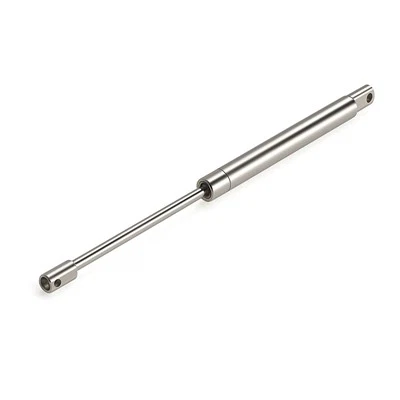
As a supplier of stainless steel gas springs, I've witnessed firsthand the significant impact that the material grade of stainless steel can have on the performance of these essential components. Stainless steel is a popular choice for gas springs due to its corrosion resistance, strength, and durability. However, not all stainless steel grades are created equal, and understanding how different grades affect gas spring performance is crucial for making informed decisions.
Understanding Stainless Steel Grades
Stainless steel is an alloy composed primarily of iron, chromium, and other elements. The addition of chromium forms a protective oxide layer on the surface of the steel, which prevents corrosion and rust. Different grades of stainless steel contain varying amounts of chromium, nickel, and other elements, which can significantly affect their properties.
The two most common grades of stainless steel used in gas springs are 304 and 316. Grade 304 stainless steel, also known as 18/8 stainless steel, contains 18% chromium and 8% nickel. It is a versatile and widely used grade that offers good corrosion resistance and strength. Grade 316 stainless steel, on the other hand, contains 16-18% chromium, 10-14% nickel, and 2-3% molybdenum. The addition of molybdenum enhances the corrosion resistance of 316 stainless steel, making it particularly suitable for applications in harsh environments.
Impact on Corrosion Resistance
One of the most critical factors in gas spring performance is corrosion resistance. Gas springs are often used in outdoor or industrial applications where they are exposed to moisture, chemicals, and other corrosive agents. The material grade of stainless steel plays a significant role in determining the gas spring's ability to withstand these harsh conditions.
Grade 304 stainless steel provides good corrosion resistance in most environments. It is suitable for general-purpose applications where the gas spring is not exposed to extreme conditions. However, in environments with high levels of chloride ions, such as coastal areas or industrial settings with saltwater exposure, grade 304 stainless steel may be susceptible to corrosion.
Grade 316 stainless steel, on the other hand, offers superior corrosion resistance compared to grade 304. The addition of molybdenum makes it highly resistant to pitting and crevice corrosion, even in chloride-rich environments. This makes grade 316 stainless steel an ideal choice for gas springs used in marine applications, food processing equipment, and other industries where corrosion resistance is critical.
For example, if you are looking for a gas spring with excellent corrosion resistance, you might consider our Stainless Steel 316 Gas Springs Corrosion-Resistant. These gas springs are designed to withstand the harshest environments and provide long-lasting performance.
Impact on Strength and Durability
In addition to corrosion resistance, the material grade of stainless steel also affects the strength and durability of gas springs. The strength of a gas spring is determined by its ability to withstand the force applied to it without deforming or breaking. The durability of a gas spring refers to its ability to maintain its performance over time, even under repeated use.
Grade 304 stainless steel has good strength and durability, making it suitable for most applications. It can withstand moderate loads and repeated use without significant deformation. However, in applications where high strength and durability are required, grade 316 stainless steel may be a better choice.
Grade 316 stainless steel has a higher tensile strength and yield strength compared to grade 304. This means that it can withstand higher loads without deforming or breaking. Additionally, the addition of molybdenum in grade 316 stainless steel enhances its resistance to stress corrosion cracking, which can significantly improve the durability of the gas spring.
If you need a gas spring with high strength and durability, our 304 316 Stainless Locking Gas Springs are an excellent option. These gas springs are available in both grade 304 and grade 316 stainless steel, allowing you to choose the material that best suits your application.
Impact on Temperature Resistance
Another important factor to consider when choosing a gas spring is its temperature resistance. Gas springs are often used in applications where they are exposed to high or low temperatures, and the material grade of stainless steel can affect their performance under these conditions.
Grade 304 stainless steel has good temperature resistance and can withstand temperatures up to approximately 870°C (1600°F). However, at higher temperatures, the strength and corrosion resistance of grade 304 stainless steel may be reduced.
Grade 316 stainless steel has better temperature resistance compared to grade 304. It can withstand temperatures up to approximately 925°C (1700°F) without significant loss of strength or corrosion resistance. This makes grade 316 stainless steel a better choice for applications where the gas spring is exposed to high temperatures.


Considerations for Choosing the Right Material Grade
When choosing the material grade of stainless steel for a gas spring, several factors should be considered. These include the application environment, the load requirements, the temperature range, and the budget.
- Application Environment: If the gas spring will be used in a corrosive environment, such as a marine or industrial setting, grade 316 stainless steel is recommended. If the application environment is less harsh, grade 304 stainless steel may be sufficient.
- Load Requirements: If the gas spring will be subjected to high loads, grade 316 stainless steel may be a better choice due to its higher strength and durability.
- Temperature Range: If the gas spring will be exposed to high temperatures, grade 316 stainless steel is recommended due to its better temperature resistance.
- Budget: Grade 316 stainless steel is generally more expensive than grade 304 stainless steel. Therefore, the budget should also be considered when choosing the material grade.
Conclusion
In conclusion, the material grade of stainless steel has a significant impact on the performance of gas springs. Grade 304 stainless steel offers good corrosion resistance, strength, and durability, making it suitable for most applications. Grade 316 stainless steel, on the other hand, provides superior corrosion resistance, higher strength, and better temperature resistance, making it ideal for applications in harsh environments or where high performance is required.
As a stainless steel gas spring supplier, we offer a wide range of gas springs in both grade 304 and grade 316 stainless steel. Our gas springs are designed to meet the highest quality standards and provide reliable performance in a variety of applications. If you have any questions or need assistance in choosing the right gas spring for your application, please don't hesitate to contact us. We are here to help you make the best decision for your needs.
References
- ASM Handbook, Volume 13A: Corrosion, ASM International
- Stainless Steel World Handbook, KCI Publishing