1. Why Machine Arm and Pad Positioning Gas Springs Matter
In welding fixtures, inspection jigs, assembly workstations, and material handling cells, operators constantly reposition arms, pads, and HMI panels. If those movements are stiff, jerky, or unstable, you get:
- Poor ergonomics and operator fatigue
- Inconsistent clamping or positioning accuracy
- Unsafe arms that drift or drop unexpectedly
Well-engineered machine arm positioning gas springs and machine pad positioning gas struts transform heavy or awkward arms into smooth, fingertip-adjustable systems. For industrial automation OEMs, choosing the right adjustable arm gas shocks, position hold gas springs for arms, and industrial positioning gas props is critical to safety, productivity, and the perceived quality of your machines.
Land Gas Springs helps OEMs worldwide design stable, precise arm and pad positioning solutions based on our portfolio of compression gas springs for arms, tension gas springs for arms, and specialized positioning and damping products.
Image suggestion 1: Industrial workstation with multiple articulated arms: one holding a clamp pad, one holding a small HMI panel, both supported by visible gas springs.
2. Gas Spring Types for Arm and Pad Positioning
Different motion and holding requirements call for different gas spring concepts:
- Compression gas springs for arms
The most common type, used to counterbalance vertical or pivoting arms and pads.
- Tension gas springs for arms
Used where the arm must be pulled into position or where a counterweight is not practical.
- Position hold gas springs for arms
Tuned so the arm stays where the operator leaves it, ideal for adjustable fixtures and ergonomic supports.
- Friction hold positioning gas springs
Built-in friction provides a "drag" that resists drift, enabling smooth manual repositioning without separate locks.
- Multi-position pneumatic struts
Designed for arms that must stop at several repeatable angles along their travel.
- Non-locking positioning gas struts
Free-moving but counterbalancing; usually combined with external ratchets, clamps, or quick locks.
- Hydraulic dampers for adjustable arms
Used when motion speed must be controlled-especially for heavier arms or safety-critical pads.
In display and HMI applications, related products such as gas lift supports for monitor arms, gas pistons for display arms, and gas rams for HMI panels use the same engineering principles, simply optimized for lighter loads and finer user feel.
Land Gas Springs can supply all of these, including heavy duty machine arm gas springs for demanding industrial environments.
Image suggestion 2: Component layout drawing comparing a standard gas spring, a friction-hold variant, and a damper, with icons showing their typical applications.
3. Design Fundamentals: Load, Geometry, and Adjustability
3.1 Calculate Loads and Torques
For any adjustable arm or pad, the starting point is understanding the load:
1.Total arm or pad weight
Include the arm structure, tool, clamp pad, or display attached at the end.
2.Center of gravity (COG)
Measure the distance from the rotation pivot to the COG. This defines the torque the gas spring must balance.
3.Operating envelope
Define the angle range the arm travels (e.g., from horizontal to vertical, or ±30° around a neutral point).
From these values, Land Gas Springs can estimate required forces for machine arm positioning gas springs, machine pad positioning gas struts, or industrial positioning gas props to deliver near "weightless" movement without overshooting or drifting.
3.2 Mounting Geometry and Stroke
Mounting geometry defines how the gas spring force is translated into useful torque:
- Stroke length must cover the full angular travel with clearance in both end positions.
- Lever arms (distances between pivot and mounting points) determine the effective force over the travel range.
- Pre-load in the neutral position helps prevent dead zones and ensures consistent support.
For arms and pads that need different feels or loads in different positions, adjustable force gas springs for arms and multi-position pneumatic struts can be used during prototyping to tune performance quickly.
Image suggestion 3: Side view of a pivoting arm with the gas spring drawn in compressed and extended positions, showing key dimensions and torque arrows.
4. Application Scenarios in Industrial Automation
4.1 Clamping Systems and Welding / Inspection Pads
In welding jigs and inspection fixtures, clamping pads and supports are constantly repositioned:
- Vertical or angled stay supports for machine pads must be stable yet easy to move.
- Heavy tooling or pad assemblies need heavy duty machine arm gas springs to reduce operator effort.
- Tight spaces and complex fixtures benefit from compact machine pad positioning gas struts.
Here, Land Gas Springs typically combines:
- Compression gas springs for arms to support pad weight
- Position hold gas springs for arms or friction hold positioning gas springs to prevent drift
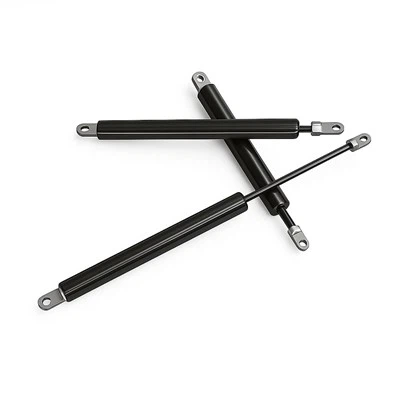
- Optional black nitrided positioning gas springs for added corrosion resistance and a clean, professional look in exposed fixtures
(Internal product link idea: Machine Pad & Fixture Positioning Gas Springs – Land Gas Springs)
Image suggestion 4: Welding fixture with several clamping pads supported by short gas springs, with one pad highlighted as an example.
4.2 Material Handling Arms and Assist Devices
In manual assist arms, balancers, or positioning booms, the operator often moves a tool or gripper through a wide range of motion:
- Adjustable arm gas shocks counterbalance arm and payload, making movement almost effortless.
- Adjustable force gas springs for arms allow fine tuning when tool mass changes.
- Tension gas springs for arms are used where pulling action is needed, such as overhead arms or telescopic supports.
For robust, industrial-grade arms used near conveyor lines or assembly cells, Land Gas Springs can provide:
- High-cycle heavy duty machine arm gas springs
- Non-locking positioning gas struts combined with external locking joints where required
- Optional hydraulic dampers for adjustable arms to control speed in long-travel or heavier applications
(Internal product link idea: Material Handling & Assist Arm Gas Springs – Land Gas Springs)
4.3 HMI Panels, Monitor Arms, and Display Supports
Machine arms are not only for tools; they also support human–machine interfaces:
- Gas lift supports for monitor arms provide smooth height and tilt adjustment.
- Gas pistons for display arms support operator tablets, barcode readers, or small panels.
- Gas rams for HMI panels hold heavier touchscreens and angled control consoles.
These applications focus on ergonomic feel and fine positioning rather than very heavy loads. Land Gas Springs provides:
- Low-friction compression gas springs for arms for smooth, precise motion
- Non-locking positioning gas struts that hold the display where the operator leaves it
- Optional small hydraulic dampers for adjustable arms where controlled speed is important, such as large HMI panels that might otherwise swing too quickly
Image suggestion 5: Automation cell with an adjustable HMI panel on a gas-spring-supported arm, showing the panel at different positions (high, low, tilted).
5. Materials, Finishes, and Environmental Performance
Industrial arms and pads often work in demanding conditions: coolant, dust, welding spatter, or outdoor exposure. When specifying machine arm positioning gas springs and related components, consider:
- Surface treatment
oBlack nitrided positioning gas springs offer excellent corrosion resistance with a sleek, dark finish that matches modern machine designs.
oOther coatings are available for extreme environments or wash-down applications.
- Seal technology
High-quality seals and guides ensure long life and stable force, especially important in high-cycle applications.
- Compatibility with other components
End fittings, brackets, and stay hardware must be sized to match expected loads and motion, especially in heavy duty machine arm gas springs for clamping systems or handling arms.
Land Gas Springs can recommend appropriate finishes and designs for dry assembly areas, oily machining environments, or light outdoor installations.
6. How Land Gas Springs Supports Industrial Automation OEMs
Land Gas Springs is a long-term engineering partner for automation and fixture OEMs, offering:
- A complete portfolio for arm and pad positioning
Including machine arm positioning gas springs, machine pad positioning gas struts, industrial positioning gas props, multi-position pneumatic struts, and hydraulic dampers for adjustable arms.
- Custom engineering and tuning
We help you calculate torques, choose between compression gas springs for arms and tension gas springs for arms, and decide when to use friction hold positioning gas springs or position hold gas springs for arms.
- OEM-focused service
From prototype support with adjustable force gas springs for arms to locked-in production specifications and private-label marking, we align with your project timelines and quality standards.
(Internal product link ideas:
Machine Arm & Pad Positioning Gas Springs – Land Gas Springs
HMI & Monitor Arm Gas Springs – Land Gas Springs)
If you are designing clamping systems, material handling arms, or HMI and display supports and need reliable machine arm positioning gas springs, machine pad positioning gas struts, or industrial positioning gas props, you can Contact us (info@lgassprings.com). Contact us to get a detailed catalog from Land Gas Springs, request professional design drawings tailored to your machine arms and pads, or discuss preferential pricing for your industrial automation OEM projects.