For fleet upfitters and OEM vehicle designers, focusing on safe operation, installation methods and force selection.
For fleets that rely on utility trucks and service vehicles, every interaction with a heavy cabinet door or toolbox lid can take extra time and create safety risks. The right gas springs for service body doors and toolbox lids allow heavy steel panels to open and close smoothly with one hand, while protecting hinges and latches and improving overall durability and user experience.
1. Common Applications of Gas Springs on Service Vehicles
On trucks, service vehicles, and utility bodies, gas springs are widely used for:
Side compartment doors and top-hinged access panels
Upper and lower cabinet door support
Horizontal and vertical tool compartments
Truck bed and side-mounted toolbox lids
Roof covers and canopy access openings
These configurations may be used individually or in combination. For example, a toolbox lid can use a damping component together with the main gas spring for smoother motion control.
2. Key Design Priorities: Safe Operation and Durability
A well-designed gas spring system should ensure that:
The door does not swing open suddenly or fall closed unexpectedly
Even a heavy steel door can be operated easily with one hand
The risk of injury to technicians during daily use is reduced
Proper selection of support struts and locking gas springs is critical for preventing hand or head injuries caused by uncontrolled door movement.
For fleet operators, gas spring failure can lead to:
Equipment downtime and interrupted service
More frequent hinge and latch maintenance or replacement
Reduced technician efficiency
That is why high-quality nitrogen-charged gas springs and corrosion-resistant black-finish surfaces are important for controlling long-term maintenance costs.
3. Technical Selection Basics: Size and Force
Before selecting a gas spring, it is necessary to determine:
The center-to-center mounting distance when the door is fully open
The compressed mounting distance when the door is fully closed
Stroke = extended length minus compressed length
Whether the gas spring will clear the body, handle, and surrounding structure throughout the full range of motion
Correct length selection is the foundation of reliable gas spring performance.
Gas spring force depends on:
Door weight, including reinforcements, handles, and seals
Mounting position and the distance from the pivot point
Whether a single or dual gas spring system is used
The goal is to achieve:
Easy opening without the door springing up uncontrollably
Stable support when the door is in the open position
Sufficient closing force for secure latching
For prototype development, adjustable-force gas springs can be charged at a higher level first and then reduced gradually to achieve the best balance.
4. Common Installation Methods
One or two gas springs are mounted inside the frame, with the rod end connected to the door
The layout should minimize twisting force and maintain stable support
Large doors may require additional support or locking hardware
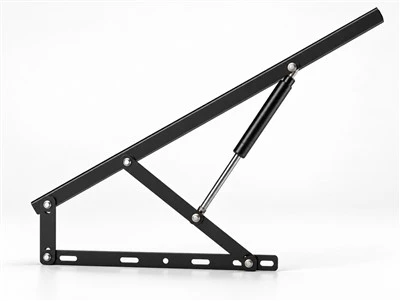
Gas springs are mounted at a calculated angle to provide enough lifting force during the initial opening stage
Intermediate stop supports can be added to improve safety
For outdoor environments, black-coated corrosion-resistant gas springs are recommended
A damping component can be added to improve soft-open and soft-close performance
In real-world vehicle upfitting and volume production, these details significantly improve usability and maintenance convenience.
5. Materials and Weather Resistance
Service vehicles are often exposed to dirt, salt, and dust. To improve service life:
Choose black-finish or corrosion-resistant coated gas springs
Use high-performance seals suited for frequent-duty operation
Consider damping components to reduce hinge impact
Good material selection and sealing design help ensure stable long-term performance.
6. Manufacturer Support and Engineering Services
As a professional gas spring manufacturer, Land provides:
Gas spring solutions for a wide range of service body doors and toolbox applications
Custom force ratings, dimensions, and end fitting options
Technical support for force calculation and CAD 2D/3D drawing integration
Sample verification and pre-production testing support
These services are designed specifically for fleet upfitters and equipment manufacturers.
7. Request Catalogs and Quotations
If you are designing a new service body, standardizing hardware across a national fleet, or upgrading an existing design, high-quality gas springs and support systems are essential for safe and efficient daily operation. Contact us for detailed catalogs, technical drawings, and OEM quotation support.