Two gas springs may both be rated at 500 N, but that does not necessarily mean they will behave the same way throughout their stroke.
One may provide relatively consistent support as a lid moves. Another may produce a larger increase in force as the piston rod is compressed, changing the effort required to close the lid.
The difference is often related to gas spring force progression, also known as the force ratio or K-factor.
For OEM engineers and purchasing teams, understanding force progression is important when specifying gas springs for RV storage compartments, marine hatches, commercial vehicle equipment, and industrial machinery.
This guide explains F1, F2, force progression, and friction characteristics, with a practical example and a checklist for OEM specification review.
1. What Is Gas Spring Force Progression?
Force progression describes how the force generated by a gas spring changes as its piston rod moves through the stroke.
In a conventional compression gas spring, the piston rod enters the cylinder during compression. The rod occupies part of the available internal volume, reducing the space available for the pressurized nitrogen. As this volume decreases, the internal gas pressure increases. This generally causes the gas spring's extension force to increase toward the compressed position.
Therefore, a gas spring does not necessarily deliver one constant force throughout its movement. The amount of increase depends on its internal design and operating conditions.
2. What Do F1 and F2 Mean?
Gas spring manufacturers commonly use F1 and F2 to identify important force values along the characteristic curve.
For a conventional compression gas spring:
F1 - Nominal Extension Force: F1 is the specified reference extension force, normally measured near the fully extended position under defined conditions (for example, 5 mm before full extension). The nominal force shown on a gas spring drawing is often associated with this reference value.
F2 - Force Near the Compressed Position: F2 represents the extension force near the compressed position. Because internal gas pressure increases during compression, F2 is typically higher than F1.
The exact force measurement positions and procedures must be confirmed with the manufacturer. For OEM purchasing, a nominal F1 rating alone may not describe the gas spring's full operating behavior.
3. Understanding the K-Factor
The K-factor describes the relationship between two defined force values along the gas spring's force characteristic:
K = F2 / F1
The corresponding percentage increase is:
Force Progression (%) = (K − 1) × 100
For example, if F1 = 500 N and F2 = 625 N, then K = 625 / 500 = 1.25, representing a 25% increase between measurement points.
4. Practical Example: Two Gas Springs Rated at 500 N
| Parameter | Gas Spring A | Gas Spring B |
|---|---|---|
| Nominal force F1 | 500 N | 500 N |
| K-factor | 1.15 | 1.30 |
| Calculated F2 | 575 N | 650 N |
| Force progression | 15% | 30% |
Illustrative engineering values only. These figures do not represent measured LAND products.
Although both gas springs are rated at 500 N, Gas Spring B exhibits a greater force increase near full compression, which may increase closing resistance depending on the hinge geometry.
5. What Determines Gas Spring Force Progression?
Several internal design factors influence force progression:
- Piston Rod Diameter: A larger rod diameter displaces more internal gas volume per unit stroke, increasing the pressure change.
- Internal Gas Volume: A larger initial gas volume results in a smaller proportional pressure increase and a flatter force curve.
- Stroke Length: Longer travel displaces more total volume relative to available cylinder space.
- Internal Construction: Internal components, oil quantity, and end plug designs alter effective gas volume.
6. Why Are Compression and Extension Forces Different?
A typical gas spring force curve contains separate paths for compression and extension, primarily caused by internal friction at the rod seal and piston guidance system (frictional hysteresis):
- During compression, external force must overcome internal friction.
- During extension, friction opposes outward rod movement.
- Additional points such as F3 and F4 are often used by manufacturers to describe compression-direction forces.
7. Why Force Progression Matters for OEM Applications?
- RV Storage Compartments: Balances open-lid holding stability with comfortable closing effort across shifting leverage angles.
- Marine Hatches: Prevents excessive closing shock on heavy deck hatches while ensuring positive lift.
- Truck Toolboxes: Ensures smooth, predictable daily operation without excessive operator fatigue.
- Industrial Machinery Covers: Protects hinges, brackets, and structural sheet metal from excessive stress near the closed position.
8. How Should OEM Buyers Specify Force Progression?
| Specification | Information to Confirm |
|---|---|
| Nominal force F1 | Required force in Newtons |
| Reference conditions | Measurement temperature, position, and method |
| F2 force | Required or acceptable force near compression |
| K-factor | Target or acceptable force ratio |
| Stroke | Required piston rod travel |
| Extended length | Defined mounting-center distance |
| Rod and tube diameters | Approved dimensional specifications |
| End fittings | Connection type and dimensions |
| Force tolerance | Approved acceptance range |
| Mounting geometry | Hinges, pivot points, and load distribution |
| Validation | Required force curve or test evidence |
9. Common Mistakes When Comparing Gas Springs
- Comparing Only the F1 Rating: Overlooking force progression and friction variations.
- Assuming a Higher K-Factor Is Always Better: Higher progression increases closing resistance near the bottom of travel.
- Confusing Friction with Force Progression: Progression is driven by gas volume displacement; friction creates hysteresis.
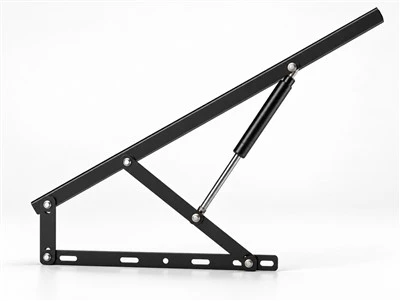
- Ignoring Mounting Geometry: Hand effort at the lid handle depends on changing hinge moment arms, not gas spring force alone.
- Assuming Identical Measurement Conventions: Always confirm supplier-specific measurement reference points.
10. How LAND Gas Springs Supports OEM Force Specification Review
LAND Gas Springs manufactures compression gas springs, locking gas springs, stainless steel gas springs, hydraulic dampers, and related mounting components for OEM applications.
Explore our Gas Spring Selection Guide, Force Calculation Basics, and OEM/ODM Capabilities.
Frequently Asked Questions
What is the difference between F1 and F2?
F1 is the nominal extension force near full extension, while F2 is the extension force near full compression.
What does a K-factor of 1.25 mean?
It means F2 is 1.25 times F1 under the stated measurement convention (a 25% force increase across the stroke).
Can two 500 N gas springs behave differently?
Yes. Variations in K-factor, internal friction, damping, rod/tube ratios, and mounting geometry significantly alter operating feel.
Is a lower K-factor always preferable?
No. Flat curves suit applications with steady required torque, while higher progression can assist heavy lids with steep leverage curves.
Is force progression the same as damping?
No. Progression is static gas pressure increase; damping is velocity-dependent hydraulic/pneumatic resistance to movement.
Should I request a complete force curve?
Yes, for critical ergonomic or narrow-tolerance applications, a continuous force-displacement chart provides full verification.
Conclusion
Selecting an OEM gas spring requires evaluating F1, F2, K-factor, internal friction, and mounting geometry together. Defining these parameters early ensures optimal ergonomic feel, structural safety, and consistent production quality.
Discuss Your OEM Gas Spring Specifications
Send LAND your application drawings, required force, mounting geometry, and operating conditions.
Website: https://www.land-gassprings.com/
Email: info@land-gassprings.com
Technical References
1. SUSPA - Gas Springs: Functionality and Spring Characteristics
https://www.suspa.com/us/products/gas-springs/
2. SUSPA - Frequently Asked Questions
https://www.suspa.com/us/products/gas-springs/faq/
3. Camloc Motion Control - Gas Strut Forces and Spring Rates
https://camloc.com/us/help-centre/finding-the-right-gas-strut/gas-strut-forces-and-spring-rates/