1. Why Chest Lid Gas Springs Matter
Heavy storage chest lids, tool chest lids, and bench seats can be dangerous if they slam shut. Fingers get pinched, lids warp over time, and the user experience feels cheap. Correctly designed chest lid stay gas springs and gas lift supports for chest lids solve all of these problems:
- They hold the lid open safely
- They control the closing speed with soft-close chest lid gas shocks
- They make even a simple wooden chest feel premium
This guide walks OEMs, furniture designers, and hardware buyers through the key steps: sizing, mounting geometry, and soft-close damping for storage chests, toy boxes, and benches.
Land Gas Springs has over 20 years of experience designing compression gas springs for storage chests, gas props for toy box lids, and gas rams for bench and chest lids. We can provide complete sizing support and custom brackets to match your furniture design.
Image suggestion 1: A cutaway sketch of a wooden toy box showing a pair of gas struts supporting the lid, with hinge, mounting points, and opening angle labeled.
2. Understanding the Different Chest Lid Gas Spring Types
For chest applications you will typically use non-locking chest lid gas springs that assist lifting and provide controlled closing, for example:
- Hydraulic chest lid struts / hydraulic dampers for chest lids – with internal oil damping for soft close.
- Nitrogen gas springs for chest lids – pure nitrogen for clean, maintenance-free operation.
- Adjustable force chest lid gas springs – force can be fine-tuned by releasing gas during testing.
- Block-lift chest lid struts – tuned to hold the lid open in a specific angle range.
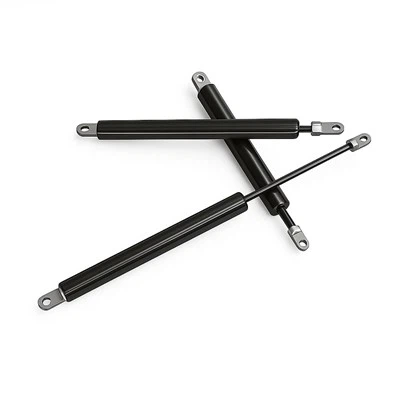
- Black nitrided chest gas struts – corrosion-resistant finish ideal for tool chests, garage storage, and outdoor benches.
For smaller gas pistons for storage boxes and stay supports for wooden chests, compact cylinders with shorter strokes are common. For long, heavy lids (e.g., industrial benches, long storage trunks) you may need tension compression gas springs for lids in customized designs.
Land Gas Springs offers all of these variants in a dedicated chest & furniture series (link to Chest Lid Gas Springs & Toy Box Struts product category).
3. Step 1 – Define Lid Weight, Dimensions, and Opening Angle
Accurate input data is the foundation for correct sizing:
1.Measure lid weight (W).
Use the real production lid or a sample, including handles, trim, and glass/metal inlays.
2.Measure lid dimensions.
oLid depth (front-to-back)
oLid width (left-to-right)
oHinge position
3.Estimate lid center of gravity.
For a uniform wooden lid, the center of gravity is approximately at half the depth.
For lids with heavy front trim or glass, it may move forward.
4.Set your design opening angle.
Common angles for lift gas springs for trunk boxes and storage chests are 70–100°.
Higher angles give better access but increase gas spring load.
Image suggestion 2: Top view of a chest lid with dimensions and center of gravity marked, plus the desired fully open angle.
4. Step 2 – Force Sizing for Chest Lid Gas Springs
The aim is to balance the torque of the lid with the torque generated by the gas springs around the hinge.
- Lid torque around hinge:
Mlid≈W×dM_{lid} \approx W \times dMlid≈W×d
where d is the horizontal distance from the hinge to the center of gravity.
- Gas spring torque:
Mgas=F×aM_{gas} = F \times aMgas=F×a
where F is the gas spring force and a is the perpendicular distance from the hinge to the gas spring line of action.
Practical rules of thumb:
- Use two gas rams for bench and chest lids for stability and reduced side loading.
- Start with gas spring force equal to 40–60% of the lid weight per side, then adjust.
- For very heavy lids (metal tool chests, industrial benches), consider heavy-duty hydraulic chest lid struts with higher force and stronger brackets.
To simplify this process, Land Gas Springs provides:
- Force calculation support based on your lid drawing
- Prototypes with adjustable force chest lid gas springs so you can tune force on site
- A full range of furniture end fittings and stay supports for wooden chests
(Internal link suggestion: "Chest & Bench Gas Spring Sizing Service – Land Gas Springs")
5. Step 3 – Mounting Geometry and Brackets
Even the best gas lift supports for chest lids will perform poorly if mounted incorrectly. Key parameters:
1.Mounting distance from hinge
oCylinder (body) usually mounts to the fixed box side.
oRod end mounts to the lid.
oTypical starting point: 70–120 mm from the hinge along the lid, and 50–90 mm below the hinge on the box side.
2.Mounting angle
In the closed position, pneumatic struts for chest covers should be slightly "pre-loaded" (pushing the lid closed). This ensures good support during lifting and stable holding at the open angle.
3.Stroke and overall length
oCompressed length must fit inside the chest when closed.
oExtended length must achieve the target opening angle without over-extending the hinges.
4.Hinge quality and stiffness
Combine gas springs with sturdy hinges. For premium tool chests, match block-lift chest lid struts with heavy-duty hinges to avoid lid twist.
Land Gas Springs can pre-engineer bracket kits for your models, including side-mount and top-mount brackets, so your assembly team only needs to position and screw in fixed points.
Image suggestion 3: Side view diagram showing a chest, hinge, gas spring, compressed and extended positions, and labeled dimensions (A, B, stroke, angle).
6. Designing Soft-Close Damping
End users now expect quiet, gentle closing even on basic furniture. To achieve this:
- Use soft-close chest lid gas shocks or hydraulic dampers for chest lids with internal oil metering.
- Specify the closing speed and last 20–30° damping zone according to your lid weight and target feel.
- For outdoor use (garden benches, deck boxes), pair black nitrided chest gas struts with stainless fittings to resist corrosion.
Land Gas Springs can provide different damping characteristics in the same external size, so you can standardize mounting while tuning the feel. For sensitive applications like toy boxes, we can combine soft-close damping with controlled opening speed using compression gas springs for storage chests engineered for children's safety.
(Internal link suggestion: "Soft-Close Gas Shocks for Toy Boxes & Storage Chests")
7. Material, Finish, and Environment
When selecting chest lid gas springs, don't forget the environment:
- Indoor furniture and toy boxes
Standard painted or nitrided steel gas props for toy box lids and gas pistons for storage boxes generally suffice.
- Garage, workshop, and tool chests
Prefer black nitrided chest gas struts for higher corrosion resistance and a sleek, technical look.
- Outdoor benches and deck boxes
Use stainless or highly corrosion-resistant designs, combined with sealed hydraulic chest lid struts to prevent moisture ingress.
Land Gas Springs offers multiple material and finish combinations across the same dimensional series, allowing OEMs to use one mounting geometry for both indoor and outdoor product lines.
8. How Land Gas Springs Supports Your Chest Lid Projects
Working with Land Gas Springs, you get more than just a standard part number:
- Custom sizing of non-locking chest lid gas springs, gas rams for bench and chest lids, and pneumatic struts for chest covers
- Professional 2D/3D drawings for your engineering team
- Sample kits with adjustable force chest lid gas springs for quick on-site tuning
- Matching hinges and stay hardware for a clean, integrated design
Whether you are upgrading a classic wooden blanket chest, designing a modular tool chest range, or building premium storage benches for hospitality projects, our engineering team can help you choose the right combination of force, mounting geometry, and soft-close damping.
If you are planning a new storage chest, toy box, or bench program and need help selecting chest lid stay gas springs, gas lift supports for chest lids, or hydraulic dampers for chest lids, simply contact us at info@lgassprings.com. You can contact us to get a detailed catalog, request professional design drawings for your chest lid layout, or discuss preferential pricing for OEM volumes.