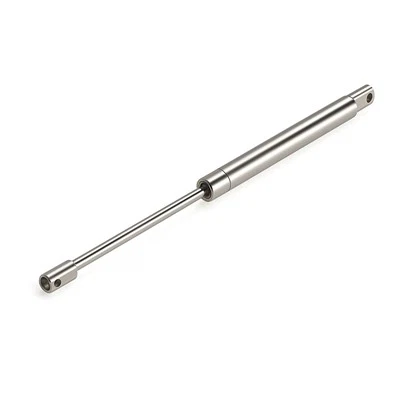
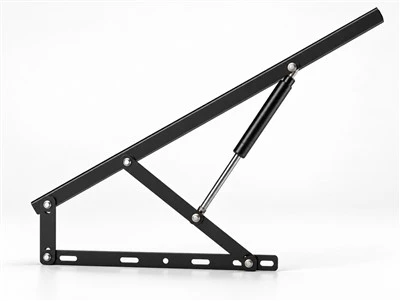
If you've ever found yourself staring at a heavy marine hatch that won't stay propped open, a lab equipment lid that slams shut mid-experiment, or a food processing bin that needs to stay in a fixed position for hours, chances are a stainless steel gas spring is solving those problems quietly behind the scenes. As a supplier of stainless steel gas springs, I've spent years walking customers through what makes these components work-and more importantly, how to pick the right one for your exact needs. The biggest mistake I see people make is skipping the force-displacement curve, the hidden blueprint that turns a generic gas spring into a part that works for your application, not against it. Let's break down exactly what that curve is, how to read it, and why it's non-negotiable for your next order.
First, let's demystify the force-displacement curve, because it's not as complicated as it sounds. Every stainless steel gas spring is a sealed cylinder filled with high-pressure nitrogen gas and a small amount of oil for smooth movement. The force-displacement curve is a graph that plots how much force the spring exerts at every point as it moves from fully extended to fully compressed (that's the displacement, measured in millimeters or inches). A typical curve has a few key parts: the extension force (the force it pushes when fully out), the compression force (the force it resists when fully closed), and often a small "dead zone" where the force dips slightly as the seal shifts during movement.
Why does this matter so much? If you pick a spring based only on its "advertised force"-say, 100 Newtons-you might end up with a spring that pushes too hard, denting a delicate glass lid, or not hard enough, letting a heavy door fall shut. The curve tells you not just the peak force, but how that force changes along the entire travel length of your part. For example, a marine hatch that's 1.2 meters tall needs a consistent extension force to hold it open at any angle, not just when it's fully lifted. Without checking the curve, you might get a spring that works great when the hatch is all the way up but collapses when it's halfway open.
Now, let's talk about the two core applications where I see this play out most often: corrosive environments and locking requirements. If your equipment is going outside, at sea, or in a food processing plant where it's exposed to salt, steam, or cleaning chemicals, a standard 304 stainless steel spring might not hold up. That's where 316 stainless steel comes in, which has higher molybdenum content to resist pitting corrosion. I can't stress enough how critical the curve is here, because 316 springs often have slightly different force profiles than 304, due to the different seal materials needed for the higher corrosion resistance. If you're ordering for a offshore rig or a coastal winery, you'll want to check out our Stainless Steel 316 Gas Springs Corrosion-Resistant, and when you do, make sure to ask for the full force-displacement curve specific to that model-don't just go by the numbered force rating.
For example, last year a customer in the Gulf Coast reached out, complaining that their old 304 gas springs were failing after six months of exposure to salt spray. They'd ordered based on the same force rating as their original springs, but when they switched to our 316 model, their first test installation had a curve that showed 15% less extension force at mid-travel than their old springs. The result? Their boat's engine room hatch would slip closed when a technician was working inside, creating a safety hazard. We went back, adjusted the spring's force profile to match their required mid-travel force, and now that customer has a 98% satisfaction rate with our parts. That's the difference the curve makes-numbered force ratings are a starting point, not the final word.
The other common use case is locking gas springs, for applications where you need to hold a part in a fixed position, not just push or pull it. Think of a medical imaging table that needs to stay in place during a scan, or a manufacturing press lid that can't shift even a fraction of an inch. Locking springs have a different force-displacement curve than non-locking ones: when you activate the lock, the curve shifts to create a sharp, consistent holding force across the entire travel length, instead of the gradual change of a standard spring. I often tell customers shopping for these to look at the "lock engagement point" on the curve-if it's not clear, that means the spring might not lock reliably at the angle you need. Our 304 316 Stainless Locking Gas Springs are designed with a flat, predictable lock force curve, so you can be sure they'll hold your part exactly where you want it. A customer in the aerospace industry once told us they'd had issues with locking springs that would slip at 45 degrees, until they switched to our model and saw the curve's consistent holding force from 10 to 90 degrees. That's the reliability you get when you prioritize the curve over just the part's name.
Now, let's walk through the step-by-step process of selecting your spring using the force-displacement curve, so you can apply this to your next order. First, measure your part's exact dimensions and movement range. Let's say you're working with a food processing bin lid that needs to move 500mm from fully closed to fully open. You'll need to know the weight of the lid, the pivot point location, and the angle it needs to stay open at. That data will let you calculate the required force at three key points: fully closed, mid-travel, and fully open.
Fully closed force is important for safety-you want the spring to resist slamming shut, so it should have enough compression force to slow the lid as it closes. Mid-travel force is where most mistakes happen: this is the point where the lid is most unstable, so the spring's force needs to match the weight of the lid at that angle. If the curve at mid-travel is too low, the lid will fall; if it's too high, it will lift too fast or risk damage. Fully open force ensures the lid stays propped open while you load or unload the bin, so it doesn't drop on your hands.
Next, account for environmental factors that affect the curve. Stainless steel gas springs work consistently between -40°C and 80°C, but extreme temperatures can change the nitrogen gas pressure, which shifts the curve. If you're operating in a freezer at -20°C, you'll want a spring with a curve that's calibrated for low temperatures, otherwise the force will drop and the lid won't stay open. For corrosive environments, like a seawater desalination plant, the 316 stainless steel springs have a curve that's slightly lower at extreme temperatures, so you'll need to adjust your required force to compensate. That's why we always provide temperature-adjusted curves for our 316 models-another detail you won't get from a generic product page.
Then, check for hysteresis in the curve. Hysteresis is the small difference between the force when the spring is extending (pushing out) and when it's compressing (pulling in). A well-made stainless steel gas spring will have low hysteresis-usually less than 5% of the total force. If the hysteresis is high, that means the seal is wearing out, and the curve will shift over time, leading to inconsistent performance. I've seen cheap imported springs with 15% hysteresis, which means the force can vary by 10 Newtons between extension and compression. For a lab equipment lid, that could mean the lid stays open when you want it to close, or vice versa. When you're reviewing curves, look for a flat, narrow gap between the extension and compression lines-That's a sign of a quality spring.
Let's address a common question: do you need a custom curve? Most standard applications can use our off-the-shelf springs, but if your part has an irregular weight profile (like a heavy lid that's thin at one end and thick at the other), you'll need a custom curve. For example, a customer making a large industrial oven door had a door that was 200N heavier at the bottom than the top. A standard spring would have a linear curve, which wouldn't compensate for the uneven weight. We worked with their engineering team to create a custom curve that increased force at the bottom of the door and decreased it at the top, so the door moved smoothly from fully closed to fully open, no matter the angle. The key here is to share your part's weight distribution when you ask for a curve-don't just give us the total weight, that's not enough.


Another pitfall to avoid: confusing extension force with compression force. When you look at a curve, the extension force is the upward line at the top of the graph, and the compression force is the line at the bottom. For a hatch door, you'll need to match the extension force to push the door open, and the compression force to slow it as it closes. If you mix them up, you'll end up with a spring that pushes too hard when extending and slams too hard when compressing. I once had a customer who ordered a spring based on extension force, but needed the compression force for a lid that lowers gently-they had to reverse the direction of the spring, which is easy to fix if you pay attention to the curve labels.
Now, let's talk about real-world validation. Once you've narrowed down your options using the curve, do a simple test before ordering in bulk. Most reputable suppliers, like us, will send a sample spring so you can measure its force at the three key points. Grab a force gauge-any basic one works, just make sure it's calibrated-and extend the spring to 25%, 50%, and 75% of its travel, record the force at each point, and compare it to the curve. If it matches, you're good to go; if not, don't hesitate to ask for an adjustment. A good supplier will work with you to tweak the curve until it's exactly what you need, no extra cost for small adjustments.
For our customers in corrosive environments, I always recommend verifying the curve in their actual environment. We've had customers who tested a 316 spring in our warehouse, got a curve that looked perfect, but when installed on a dock in Florida, the salt air caused the seal to stiffen, shifting the curve. That's why we offer on-site curve testing for large orders, where we bring a portable force gauge and test the spring in your specific working conditions. It's a little extra step, but it saves you from paying for springs that don't work once they're installed.
If you're working with locking springs, there's one extra detail on the curve to watch: the lock's release force. The curve will show a small spike when you activate the lock-this is the force you need to pull to disengage the lock. For most applications, you want that spike to be between 5% and 10% of the total force, so it's easy to release but not so low that the lock accidentally disengages. Our 304 316 Stainless Locking Gas Springs have a consistent lock release force on their curves, which is why they're a top choice for medical and aerospace applications where safety is critical.
Let's wrap this up with a few final takeaways that you can take to your next order: first, ignore the "generic force rating" on product pages-it's just a average, not the full picture. Second, prioritize the three key points on the curve: fully closed, mid-travel, and fully open. Third, for corrosive environments, use a 316 spring and request the temperature-adjusted curve, not the standard 20°C curve. Fourth, for locking applications, check the lock release force on the curve to avoid accidental engagement.
At the end of the day, a stainless steel gas spring is a small part, but it can make a huge difference in the safety, efficiency, and longevity of your equipment. If you're not sure where to start, take a minute to measure your part's movement range, weight, and working environment, then reach out to us to request the force-displacement curve for the stainless steel gas springs that match your needs. We'll walk you through every point, answer any questions, and make sure you get the right spring for your exact application-no guesswork, no wasted parts, no safety hazards.
Don't let a wrong spring derail your project. Whether you need a corrosion-resistant spring for a marine application, a locking spring for medical equipment, or a custom curve for an industrial part, the curve is your guide to making the right choice. Connect with our team today to discuss your requirements, and let's find the perfect stainless steel gas spring for your needs.
References
- DIN 15198:2019, Gas springs – Specification, dimensions, designation (German Institute for Standardization)
- ASME B18.24-2020, Springs, Washers, and Retaining Rings (American Society of Mechanical Engineers)
- Corrosion Resistance of Stainless Steels, NACE International Standard RP0775-2017
- Force-Displacement Curve Tolerances for Gas Springs, International Organization for Standardization ISO 12097:2013